
Key takeaways
- Neck pain on your side is a height and contour problem. Compare five pillows by cervical profile, from solid foam contours to fully adjustable fills.
What's inside
As an Amazon Associate I earn from qualifying purchases. This post may contain affiliate links at no extra cost to you.
Strip away every variable and neck pain for a side sleeper comes down to one angle: the angle your neck makes with your shoulders while you sleep. Too little pillow and the head drops, bending the neck toward the mattress; too much and it cranks the other way. Everything in this category, contour ridges, profile heights, cutouts, adjustable fills, is a different mechanism for holding that angle at neutral. Shopping by softness adjectives instead of profile measurements is why the search fails.
That measurement-first approach suits side sleepers who wake with a sore neck, people choosing between the small, medium and large profiles of a contour pillow, and anyone unsure whether their frame needs a tall or moderate height. The five pillows were chosen from their Amazon listing names and specifications for cervical support: a solid TEMPUR contour in three heights, a latex cutout that supports the neck from a level base, a cube for wide shoulders, an adjustable cutout for height control, and a moldable shredded-fill option.
Quick Picks
As an Amazon Associate we earn from qualifying purchases.
| Product | Best for | Key spec from title |
|---|---|---|
| Tempur-Pedic TEMPUR-Ergo Neck Pillow | A true cervical contour in three heights | Solid TEMPUR contour, firm, 4 inch medium profile |
| Eli & Elm Side Sleeper Pillow | Neck support with shoulder clearance built in | U-shape cutout with cooling latex fill |
| Cube Memory Foam Pillow | Maximum height for the widest shoulders | Solid cube profile, 24 x 12 x 6 inches |
| Coop Eden Cut-Out Pillow | Adjustable height around a shoulder notch | Gel memory foam cut-out, adjustable |
| Snuggle-Pedic Pillow | A moldable surface you shape each night | Shredded fill with Kool-Flow vented cover |
How to Choose
Profile height is the primary spec
For a contour pillow, the profile height is the product. The Tempur-Pedic in this list comes in small, medium and large profiles at roughly three, four and four-and-three-quarter inches, and picking among them matters more than any other feature on the page. Estimate your need by measuring from the mattress to your jaw while lying on your side with your shoulder settled in. Broad shoulders push you up the range; narrow frames and softer mattresses that let the shoulder sink push you down it.
Contour shape versus flat top
A cervical contour raises the neck onto a ridge and lowers the head into a bowl, which actively holds the neck’s curve rather than merely propping the head. That active shaping suits sleepers who remain in one position and want the pillow to enforce alignment. A flat-topped pillow leaves placement to you and tolerates movement, but its support depends entirely on height. If you have never slept on a contour, expect an adaptation stretch; the shape feels deliberate in a way flat pillows never do.
Fill response under the neck
How a fill behaves over eight hours decides whether the measured height survives the night. Solid foam and latex hold their profiles most faithfully, which is why they dominate cervical designs. Shredded fills can be molded into a neck ridge by hand and feel familiar to conventional-pillow sleepers, but the ridge softens and migrates. Gel foam blends sit between the two. If your neck pain is worst in the early morning, suspect overnight compression and lean toward the fills that move least.
Shoulder interaction at the pillow’s edge
Even a neck-focused pillow fails if its edge digs into the shoulder and shoves the whole arrangement upward. Cutout designs remove that interference entirely by letting the shoulder occupy the pillow’s footprint. With straight-edged pillows, the practical check is whether the pillow is firm enough at the border to stay put rather than sliding. Neck pain shoppers often ignore the shoulder completely, then blame the contour, when the real culprit was the shoulder levering the pillow out of position all night.
The 5 Best Options
Tempur-Pedic TEMPUR-Ergo Neck Pillow

This is the reference cervical contour in the group: solid TEMPUR material moulded so the neck rests on a supportive ridge while the head settles lower, keeping the neck’s natural curve instead of flattening or bending it. The medium profile listed here stands four inches high, with smaller and larger profiles in the same line for different shoulder widths. It is firm to extra-firm, so the geometry does not soften away overnight. The description lists it for side and back sleeping, and the removable cover washes.
Specs
- Solid TEMPUR material, contoured cervical shape
- Firm to extra-firm feel
- Medium profile, 4 inches high
- Small and large profiles also in the line
- 20 x 12.5 inches
- Listed for side and back sleeping
- Hypoallergenic
- Removable, washable cover
- OEKO-TEX Standard 100 certified
Best for: Side sleepers who want a dedicated cervical contour sized to their frame.
Watch out for: The profile choice is final, there is no adjustment, so measure carefully between the three heights.
ASIN: B07CMFSY97
Eli & Elm Side Sleeper Pillow

The neck support here comes from a level, resilient surface rather than a ridge: the cooling latex fill holds its height under the head, while the U-shaped cutout keeps the shoulder from pushing the pillow upward and bending the neck from below. That makes it a strong option when your neck pain arrives with shoulder pressure attached. Latex also responds instantly when you shift, unlike slow foams. The breathable cover and included case keep the setup simple, and the Queen footprint suits standard bedding.
Specs
- U-shaped shoulder cutout for side sleeping
- Cooling latex fill
- Breathable cover
- Queen size, 17 x 29 inches
- Pillow and case set
- OEKO-TEX Standard 100 certified materials
Best for: Neck pain sleepers whose shoulder keeps displacing the pillow during the night.
Watch out for: Side sleeping only; the cutout shape has nothing to offer when you roll onto your back.
ASIN: B093CN3KV3
Cube Memory Foam Pillow
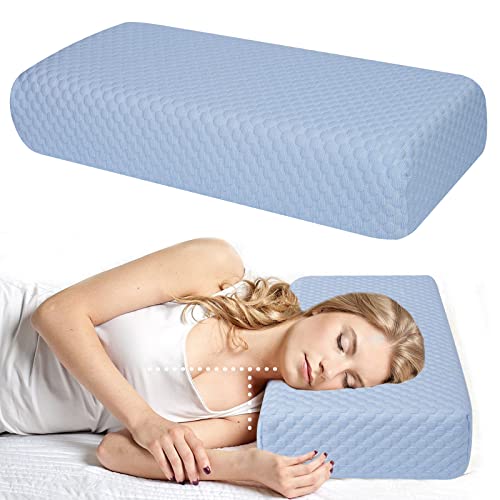
Height is this pillow’s entire argument, and for the widest shoulders it is a convincing one. The solid foam cube stands six inches tall with straight sides, so a broad-shouldered sleeper’s head finally rests level instead of dropping toward the mattress, which is the single most common neck-bending setup. The flat top keeps placement simple, and the cooling cover addresses the warmth a large foam block can hold. A four-inch version in the same listing family covers narrower frames who like the geometry but not the altitude.
Specs
- Solid memory foam cube construction
- 24 x 12 x 6 inches, extra thick profile
- 4 inch version also listed for narrower shoulders
- Cooling cover
- Shaped for cervical positioning
Best for: Broad-shouldered side sleepers whose necks bend because standard pillows are too low.
Watch out for: Six inches is excessive for average frames, and the blocky shape needs an adjustment period.
ASIN: B0BPMDN3QJ
Coop Eden Cut-Out Pillow
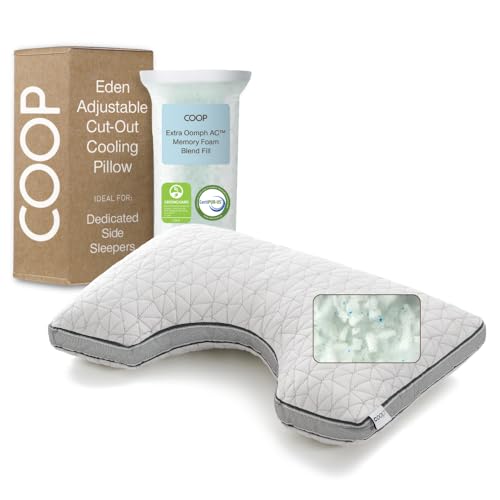
This design treats neck height as a variable rather than a fixed bet. The gel memory foam and microfiber fill adjusts by the handful, so you can raise or lower the surface under your neck in small steps across several nights until the morning stiffness tells you that you have arrived. The ergonomic shoulder cutout keeps the shoulder out of the equation while you tune. It runs medium soft, which suits necks that dislike the insistence of solid foam, and the removable cover keeps the experiment hygienic.
Specs
- Gel memory foam and microfiber fill
- Ergonomic shoulder cut-out shape
- Adjustable fill level
- Medium soft feel
- Removable cover
- CertiPUR-US and GREENGUARD Gold certified
Best for: Sleepers who want to converge on their exact neck height gradually.
Watch out for: The medium soft fill may never feel firm enough if your neck clearly prefers a solid ridge.
ASIN: B0G2PG7WPX
Snuggle-Pedic Pillow
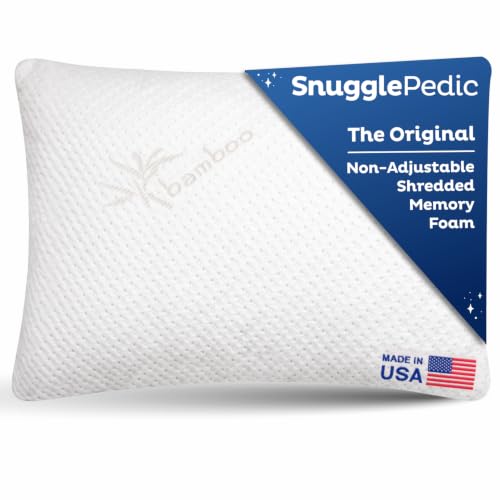
The moldable entry in the list: shredded memory foam and fibre fill that you can bunch into a ridge under the neck and flatten under the head, rebuilding a personal contour every night. The Kool-Flow micro-vented cover is designed to move air through that shredded fill, and the whole pillow is washable, which shredded designs need more than most. It carries CertiPUR-US and GreenGuard Gold certifications and is made in the USA. The Queen listed here measures 28 by 20 inches, with standard and king sizes in the line.
Specs
- Shredded memory foam and fibre fill
- Kool-Flow micro-vented cover
- Queen size, 28 x 20 inches
- Whole pillow washable
- CertiPUR-US and GreenGuard Gold certified
- Made in the USA
Best for: Sleepers who want to hand-shape neck support and dislike fixed contours.
Watch out for: There is no fixed contour, so the ridge you build migrates and needs re-shaping regularly.
ASIN: B00PBFP0S6
Which One Fits Your Situation
You want the pillow to enforce the position
Choose the Tempur-Pedic Ergo Neck and spend your effort on the profile size. Its solid contour does the holding for you, night after night, with no tuning. That enforcement is exactly what a neck that keeps sliding into a bend needs, provided the height matches your shoulders. Check the size chart twice.
Your neck pain comes with shoulder pressure
The Eli & Elm separates the two problems: the cutout parks the shoulder, the latex surface holds the neck level. If every pillow you try ends up shoved upward by morning, the interference is coming from below, and this is the design that removes it while keeping support resilient rather than sinky.
You are tall or broad across the shoulders
Start with the Cube Pillow’s six-inch profile. Most standard pillows simply cannot fill the mattress-to-head gap on a large frame, so the neck bends no matter how good the material is. Solve the geometry first; if six inches overshoots, the four-inch sibling keeps the same idea at a saner height.
You have guessed wrong on height before
The Coop Eden Cut-Out is your insurance policy. Adjust in small steps, sleep a full night on each setting, and let morning stiffness arbitrate. It takes longer to dial in than a fixed contour, but it cannot be the wrong height in the way a fixed pillow can. That flexibility is the point.
Common Mistakes
- Ordering a contour pillow’s profile size by bed size instead of by shoulder width.
- Judging neck support by how the pillow feels in your hands rather than under your head at 3 a.m.
- Ignoring the shoulder’s role in pushing the pillow out of position overnight.
- Switching shapes every two nights instead of giving one geometry a fair trial week.
- Assuming softer means gentler on the neck, when a collapsing pillow bends it further.
Frequently Asked Questions
What pillow height is right for side sleeping neck pain?
The right height fills the gap between the mattress and your head so the neck runs straight, neither dipping nor cranking upward. Measure that gap lying down: it commonly lands between four and six inches depending on shoulder width and how much your shoulder sinks into the mattress. Use the measurement, not the pillow’s marketing label, as your guide.
Are contour pillows uncomfortable at first?
Often, yes, briefly. A cervical contour holds your neck in a position your muscles may not be used to, and mild unfamiliarity for several nights is normal while they adapt. What should improve across the first week is the morning stiffness trend. If discomfort sharpens instead of easing, the profile height is probably wrong for your frame.
Is memory foam or latex better for neck support?
Both hold a profile well; they differ in response. Memory foam moulds slowly and stays where it settles, which suits still sleepers. Latex springs back instantly and feels more buoyant, which suits sleepers who shift position and want the support to follow. For pure neck-angle consistency either works, so choose by the feel you will actually tolerate nightly.
When is neck pain not a pillow problem?
Pain that radiates into the arm, comes with numbness or weakness, follows an injury, or persists unchanged through several well-fitted pillows deserves professional evaluation rather than more shopping. A pillow corrects sleeping geometry; it does not diagnose. Treat a good pillow as one variable to rule out, and escalate when the evidence says the variable was not the cause.
Related guides
More from Amazon
Programs that pair well with the guide above. Offers and eligibility are set by Amazon and may change.
Free shipping on eligible items, Prime Video and more. Eligible new members can start with a free trial.
Start a Prime free trialAudiobooks and podcasts to listen to on the go. Eligible new members can start with a free trial.
Try Audible freeAd-free music streaming. Eligible new subscribers can start with a free trial.
Try Music Unlimited freeA free business account with business pricing and bulk-buying tools for work, shop or home office.
Create a business accountAs an Amazon Associate we earn from qualifying purchases.

Write Your Review
No reviews yet. Be the first to share your experience!